


How Often Should You Replace an Engine Air Filter?
Your vehicle manufacturer's maintenance schedule should be your main reference.
Different vehicles use different filter designs, engine layouts, and service schedules, so a universal replacement interval can be misleading. AAA also recommends regular engine-air-filter inspection and replacing the filter when needed rather than assuming every vehicle requires the same schedule.
A simple decision process is:
- Check your owner's manual.
- Follow the manufacturer's scheduled interval.
- Inspect more often if you regularly drive in dusty conditions.
- Service the filter according to its specific design and manufacturer instructions.
This approach is more reliable than choosing an arbitrary mileage.
Do Driving Conditions Affect Air Filter Service?
Yes. The driving environment can affect how quickly an engine air filter collects dust and debris.
Vehicles used mostly on paved suburban or highway roads may experience different filter loading than vehicles regularly driven on:
- Dirt roads
- Gravel roads
- Construction routes
- Dusty rural roads
- Desert roads
- Off-road trails
This is not just general maintenance advice. Toyota's 2024 RAV4 maintenance guide specifically lists engine air filter inspection as an additional maintenance item for vehicles driven on dirt or dusty roads.
That means two vehicles with similar mileage may not need air-filter service at the same time.
What to Check During an Engine Air Filter Inspection
An inspection should involve more than simply looking at the mileage.
When the filter is accessible, check the condition of the filter and the surrounding air box.
Look for:
- Heavy accumulation of dirt or debris
- Leaves, insects, or other material inside the air box
- Torn or damaged filter media
- Crushed or distorted filter edges
- Damage around the sealing surface
- A filter that is not seated correctly
- Loose air-box clips or fasteners
Proper fit is important because the filter needs to sit correctly in its housing.
Do not automatically assume that a filter needs replacement just because its surface has some visible dirt. AAA notes that visible dirt alone is not always a reliable indicator of filter condition. It also explains that inspection methods can vary depending on the type of filter media.
If you need to confirm the correct application for your vehicle, Green Filter's Shop by Vehicle page lets you search by vehicle fitment.
Does a Dirty Engine Air Filter Always Need Replacement?
Not necessarily. It depends on the filter type.
Disposable Engine Air Filters
Most conventional disposable engine air filters are intended to be replaced rather than washed or serviced.
Follow the vehicle and filter manufacturer's instructions when determining when replacement is required.
Reusable Engine Air Filters
Some aftermarket engine air filters are specifically designed to be cleaned and reused.
However, reusable filters should only be serviced according to the instructions for that particular filter. Different filter media and designs may require different cleaning or oiling procedures.
Do not assume that every reusable filter can be washed, dried, or oiled in the same way.
Green Filter owners can follow the company's reusable air filter cleaning guide for the recommended maintenance process for Green Filter products.
Can You Wait Too Long to Service an Engine Air Filter?
An air filter should not simply be left in place indefinitely.
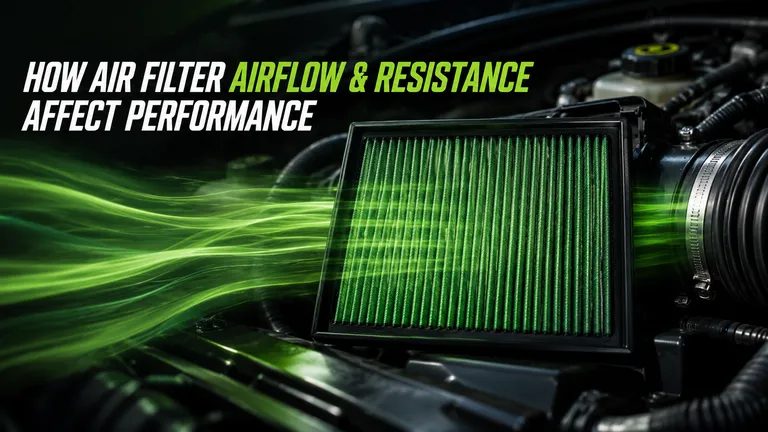
As a filter becomes increasingly restricted, airflow through it can decrease. AAA notes that a badly restricted engine air filter can reduce maximum power output in modern fuel-injected vehicles.
Damage or an improper fit is a different concern. A filter that is torn, distorted, or incorrectly seated should be addressed rather than left in service.
The goal is not to replace an air filter as frequently as possible. The goal is to keep the correct filter properly fitted, inspected, and maintained according to the vehicle and filter manufacturer's guidance.
For broader replacement information, see Green Filter's engine air filter replacement guide.
Should You Replace the Air Filter at Every Oil Change?
Usually, these should be treated as separate maintenance items.
An oil-change schedule does not automatically determine the engine-air-filter replacement schedule.
However, routine vehicle maintenance can be a convenient opportunity to inspect the engine air filter. AAA recommends regular inspection and notes that filter service requirements vary with condition and driving environment.
Your owner's manual remains the best source for your vehicle's actual replacement schedule.
A Simple Rule to Follow
If you are unsure how often to replace your engine air filter, use this order:
Manufacturer schedule → filter inspection → driving conditions → filter-specific service instructions.
Check the owner's manual first.
Then consider whether your vehicle sees unusually dusty or dirty conditions. Inspect the filter and housing for damage, excessive debris, or fitment problems. Finally, follow the correct maintenance procedure for the specific disposable or reusable filter installed.
This gives you a more useful answer than relying on one mileage number for every vehicle.









Comments
Loading comments...
Leave a Comment