

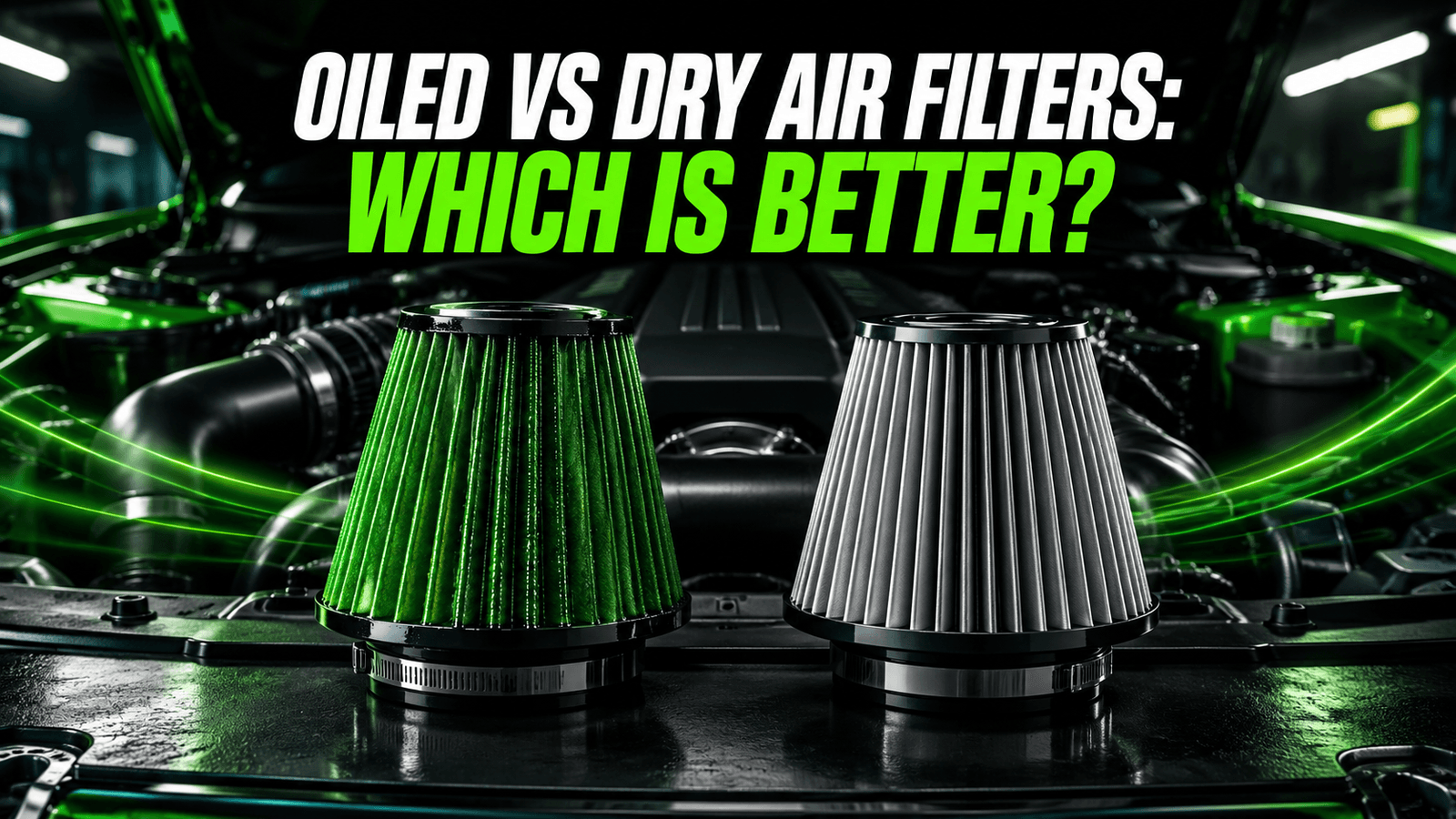
Choosing between an oiled vs dry air filter is not as simple as saying one type is always better.
Both designs can provide effective engine filtration and performance-oriented airflow when they are properly designed, sized, installed, and maintained. The biggest differences are usually the filter media, how contaminants are captured, and how the filter is serviced.
For drivers, the practical choice often comes down to this:
Oiled filters suit drivers who want a reusable performance filter and are comfortable cleaning and re-oiling it correctly. Dry filters suit drivers who prefer a reusable filter that does not require oil during servicing.
The right choice depends on the specific filter design and how you use your vehicle.
Oiled vs Dry Air Filters at a Glance
| Feature | Oiled Performance Filter | Dry Performance Filter |
|---|---|---|
| Filter media | Often cotton-based or similar reusable media | Often synthetic performance media |
| Uses filter oil | Yes | No |
| Washable | Often | Often |
| Re-oiling required | Yes | No |
| Maintenance | Cleaning + correct re-oiling | Cleaning, then drying |
| Airflow | Depends on filter design | Depends on filter design |
| Filtration | Depends on media and construction | Depends on media and construction |
| Best choice | Drivers comfortable with servicing | Drivers wanting simpler maintenance |
The important point is that “oiled” or “dry” alone does not tell you which filter has better airflow or filtration. Actual performance depends on the complete filter design.
How Does an Oiled Performance Air Filter Work?
Many reusable oiled performance filters use porous media that is treated with a specially formulated filter oil.
The oil helps contaminants adhere to the filtration system as air moves through the filter. Because this type of filter is reusable, it can usually be cleaned and then re-oiled instead of being discarded.
Green Filter uses a washable, reusable oiled filtration system. According to Green Filter, its filters use woven cotton media and a proprietary lightweight synthetic filter oil designed to help hold contaminants while supporting airflow through the media.
You can learn more about Green Filter's construction in the Why Choose Green Filter guide.
The main responsibility with an oiled filter is maintenance. After cleaning, the filter should be fully dried and the correct amount of approved filter oil should be applied.
Too little maintenance can reduce filter performance, while unnecessary or incorrect oil application should be avoided.
How Does a Dry Performance Air Filter Work?
A dry performance air filter captures dust and debris without relying on filter oil. Most reusable dry filters use synthetic media designed to trap contaminants while allowing consistent airflow through the filter.
Because no oil is required, maintenance is generally straightforward. The filter can be cleaned according to the manufacturer's instructions, allowed to dry completely, and then reinstalled.
Some manufacturers offer washable, reusable synthetic dry filters specifically designed for performance applications. This shows that reusable performance air filters can use either dry or oiled filtration media, depending on the design and intended application.
Which Has Better Airflow: Oiled or Dry?
There is no reliable universal rule that every oiled filter flows more air than every dry filter, or vice versa.
Airflow depends on factors such as:
- Filter media
- Pleat depth and surface area
- Filter dimensions
- Media density
- Construction
- Airflow demand
- Pressure drop through the filter
Some manufacturers offer both oiled and dry filters with different airflow characteristics within their own product ranges. That does not mean the same comparison applies to every brand or every application.
This is why product-specific testing matters more than a broad “oiled vs dry” claim.
Industry air-filter evaluation commonly looks at characteristics such as airflow restriction, filtration efficiency, and dust-holding capacity. SAE technical literature also discusses ISO 5011 comparative testing for engine intake filter media.
For drivers, the better question is:
Does this particular filter provide the airflow and filtration required for my engine and driving conditions?
Which Filter Is Easier to Maintain?
This is where the difference is much clearer.
A dry reusable filter generally has the simpler servicing process because it does not need to be re-oiled after cleaning.
An oiled filter requires an additional step. After cleaning and drying, the correct filter oil must be applied according to the manufacturer's instructions.
Green Filter recommends inspecting its filters at every oil change and generally cleaning them around 30,000 miles under normal driving conditions, with more frequent attention in dusty or dirty environments. After cleaning, Green Filter requires re-oiling with its approved filter oil.
For the full process, see our How to Clean a Reusable Air Filter guide.
Which Is Better for Daily Driving?
For daily driving, either design can work well when the filter is properly matched to the vehicle.
A dry performance filter may appeal to someone who wants the simplest possible maintenance routine and does not want to apply filter oil.
An oiled performance filter may appeal to a driver who prefers a reusable filtration system and is comfortable following the correct cleaning and re-oiling procedure.
The decision should not be based on oil alone. Proper fitment, filtration, airflow characteristics, service intervals, and manufacturer instructions are more important.
If your main goal is long-term reusable filtration, our Washable Air Filter Guide explains what to consider before choosing a reusable filter.
What About Dusty or Off-Road Conditions?
Dusty environments can load any air filter more quickly.
The correct response is not automatically to choose “oiled” or “dry.” Instead, pay closer attention to inspection intervals, filter capacity, proper sealing, and the manufacturer's servicing recommendations.
Green Filter specifically recommends more frequent inspection and cleaning when a vehicle is used in dusty, off-road, agricultural, construction, or similarly dirty environments.
No filter type should be treated as maintenance-free in severe conditions.
Where Does Green Filter Fit Into the Comparison?
Green Filter uses an oiled, washable, reusable performance-filter design rather than a dry synthetic system. Its filters use woven cotton filtration media, steel mesh support, and a proprietary filter oil.
That means a Green Filter should be maintained as an oiled filter.
After cleaning, allow the filter to dry naturally and apply Green Filter oil according to the recommended procedure. Green Filter specifically advises against over-oiling and provides its own Cleaner & Care system for servicing its filters.
See the Green Filter Cleaner & Care guide for the correct maintenance process.
So, Which Is Better: Oiled or Dry?
Neither design is automatically better for every driver.
Choose based on the specific product and how you prefer to maintain your vehicle.
An oiled filter may be the better fit if you want a washable performance filter and do not mind properly cleaning and re-oiling it.
A dry filter may be the better fit if you prefer a washable performance filter without the additional oiling step.
What matters most is that the filter provides appropriate filtration, airflow, correct fitment, and proper sealing for your application.
The Bottom Line
The oiled vs dry air filter debate does not have one universal winner.
Both designs can work effectively, and both can be built for reusable performance applications. Oiled filters require correct re-oiling after cleaning, while dry filters remove that maintenance step.
Instead of choosing based on the label alone, compare the actual filter design, filtration performance, airflow characteristics, fitment, and servicing requirements.
Green Filter uses a washable, reusable oiled design for its performance air filters. If that type of filtration fits your needs, use the Shop by Vehicle tool to find the correct filter for your vehicle.









Comments
Loading comments...
Leave a Comment