

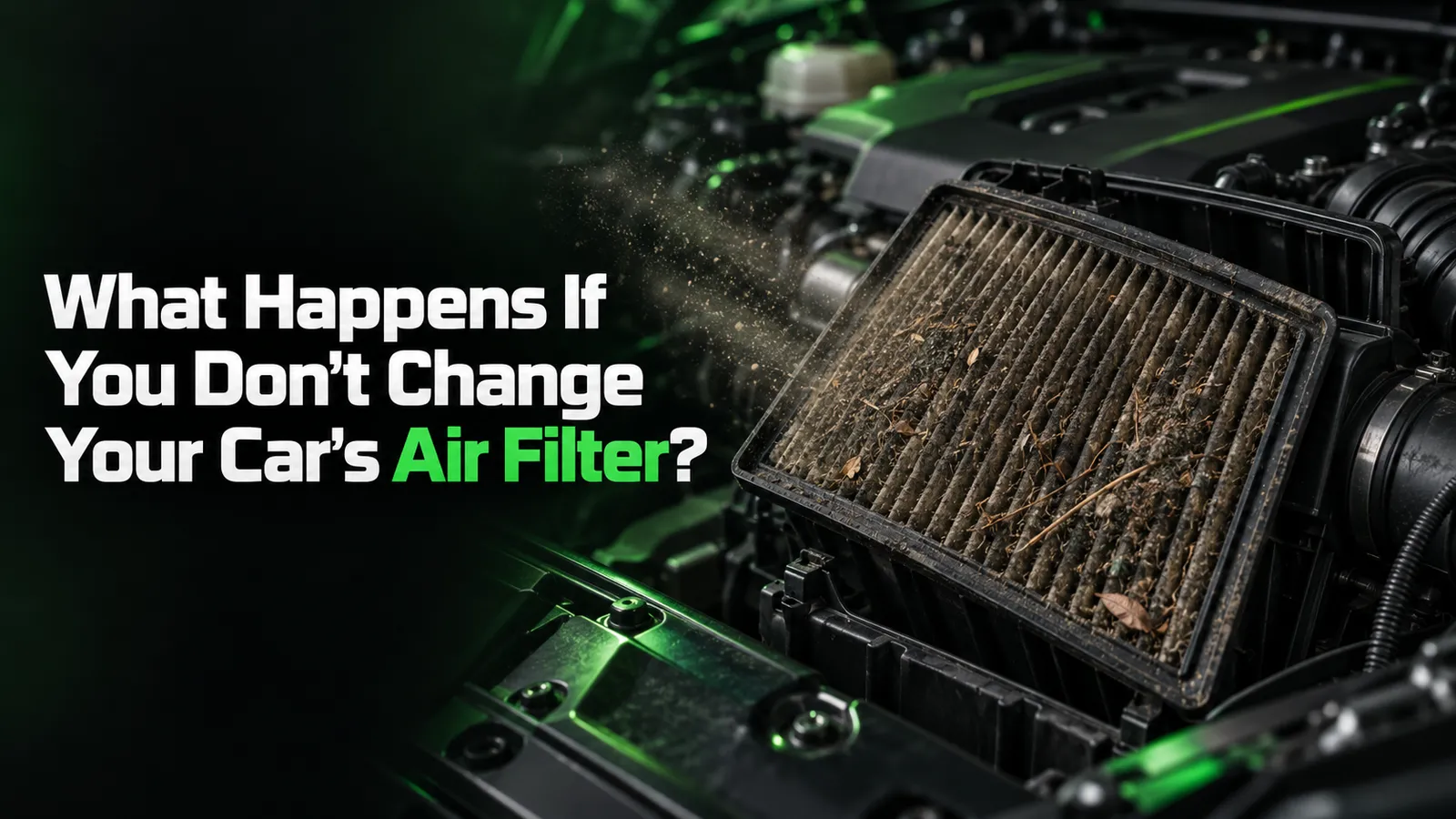
If you don’t change or properly service your car’s engine air filter, dirt and debris can continue building up until airflow becomes restricted. A heavily clogged filter can reduce acceleration and maximum engine power. If the filter becomes damaged, distorted, or poorly sealed, it can also reduce the protection your engine receives from airborne contaminants.
Here’s what actually happens, and when you should take action.
What Does Your Car’s Engine Air Filter Do?
Your engine needs air for combustion. Before outside air reaches the engine, it passes through the engine air filter.
The filter helps trap road dust, dirt, insects, and other debris while allowing enough air to reach the engine.
Over time, those contaminants collect in the filter media. That is normal. The problem starts when the filter becomes excessively restricted, damaged, or is left in service longer than recommended.
If you’re unsure when your filter needs attention, Green Filter’s How Often to Replace Engine Air Filter guide explains why the correct service interval depends on your vehicle and driving conditions.
1. Your Engine May Get Less Air
A heavily loaded engine air filter creates additional resistance in the intake system.
When restriction becomes severe enough, the engine may not receive as much air as it can use during higher-demand situations such as hard acceleration, passing, climbing hills, or driving at higher RPM.
This does not mean that a slightly dirty filter will suddenly make your car run badly. Air filters are designed to collect dirt. The concern is allowing the filter to become excessively clogged.
2. Acceleration and Maximum Power Can Drop
One of the clearest effects of a severely restricted engine air filter is reduced performance.
A U.S. Department of Energy-sponsored study conducted by Oak Ridge National Laboratory found that clogged air filters did not significantly reduce fuel economy in the modern fuel-injected gasoline vehicles tested, but replacing the restricted filter improved acceleration performance.
You can review the Oak Ridge National Laboratory air-filter study for the original research reference.
In everyday driving, excessive restriction may make the vehicle feel less responsive when you ask the engine for more power.
For more information about airflow and responsiveness, see Green Filter’s performance air filter and throttle response guide.
3. A Dirty Air Filter Does Not Automatically Mean Worse Gas Mileage
This is where a lot of automotive advice becomes misleading.
For older carbureted vehicles, a severely clogged air filter can affect fuel economy. Modern fuel-injected gasoline engines, however, use electronic engine management systems to control the air-fuel mixture.
The DOE-sponsored research found no significant fuel-economy loss in the newer fuel-injected vehicles tested, even though severe restriction affected performance.
AAA also notes that a badly restricted filter can reduce maximum power in modern vehicles without necessarily causing the fuel-economy loss commonly associated with older carbureted cars.
Read the AAA engine air filter guidance.
So the better reason to maintain your engine air filter is proper airflow, performance, fitment, filtration, and engine protection—not an exaggerated MPG promise.
4. A Damaged or Poorly Seated Filter Can Become a Bigger Problem
Being dirty and being damaged are not the same thing.
A filter should be inspected for more than surface dust. Problems can include torn filter media, distorted edges, damaged sealing surfaces, loose air-box fasteners, or a filter that is not seated correctly.
If the filter does not seal properly, air may find a path around the filter instead of passing through the filtration media.
That is why correct fitment matters.
If your current filter is damaged or needs replacement, Green Filter’s Engine Air Filter Replacement Guide explains how to choose the correct replacement.
5. Dusty Driving Can Make the Filter Need Attention Sooner
Not every car loads its air filter at the same rate.
A vehicle driven primarily on paved highways may experience very different conditions from one regularly used on:
- dirt or gravel roads
- dusty rural roads
- construction sites
- agricultural areas
- desert roads
- off-road trails
These environments can expose the filter to considerably more airborne debris.
Instead of relying only on mileage, follow your vehicle manufacturer’s maintenance schedule and inspect the filter more frequently when driving conditions are unusually dusty.
Should You Replace a Dirty Air Filter or Clean It?
That depends on the type of engine air filter installed.
Disposable filters are normally replaced when they reach their recommended service condition.
Washable reusable filters are designed to be serviced and used again rather than routinely thrown away.
Green Filter recommends visually inspecting its reusable filters around regular maintenance intervals and, under normal conditions, cleaning them around every 30,000 miles. Dusty or dirty environments may require earlier attention.
If you already use a reusable Green Filter, follow the How to Clean a Reusable Air Filter guide and use the appropriate Cleaner & Care system.
How Can You Tell If Your Air Filter Needs Attention?
The simplest approach is to inspect it rather than waiting for a dramatic symptom.
Check for excessive debris, damaged media, distorted edges, problems with the sealing surface, or an incorrectly seated filter. Then compare its condition with the maintenance recommendations for your specific vehicle and filter.
If you do need another filter, avoid buying one simply because it looks similar to the old one. Correct year, make, model, engine, and air-box fitment matter.
You can use Green Filter’s Shop by Vehicle tool to check compatible reusable engine air filters for your vehicle.
The Bottom Line
Ignoring your engine air filter for too long can eventually restrict airflow and reduce acceleration or maximum engine performance. More importantly, a damaged or poorly fitted filter may not provide the protection the intake system needs.
The solution is simple: inspect the filter, follow your vehicle’s maintenance guidance, and service or replace it according to its design.
Need a filter for your vehicle? Use Green Filter’s Shop by Vehicle tool to search by year, make, model, and engine and find a compatible reusable air filter.







Comments
Loading comments...
Leave a Comment